Operations & Systems
S&D's Detailing LLC
A mobile detailing business I co-founded and helped systemize from customer intake through job closeout. I designed the website and backend workflow that validates requests, applies pricing rules, records customer data, coordinates scheduling, and keeps each job and expense traceable.
System overview
From customer request to confirmed appointment
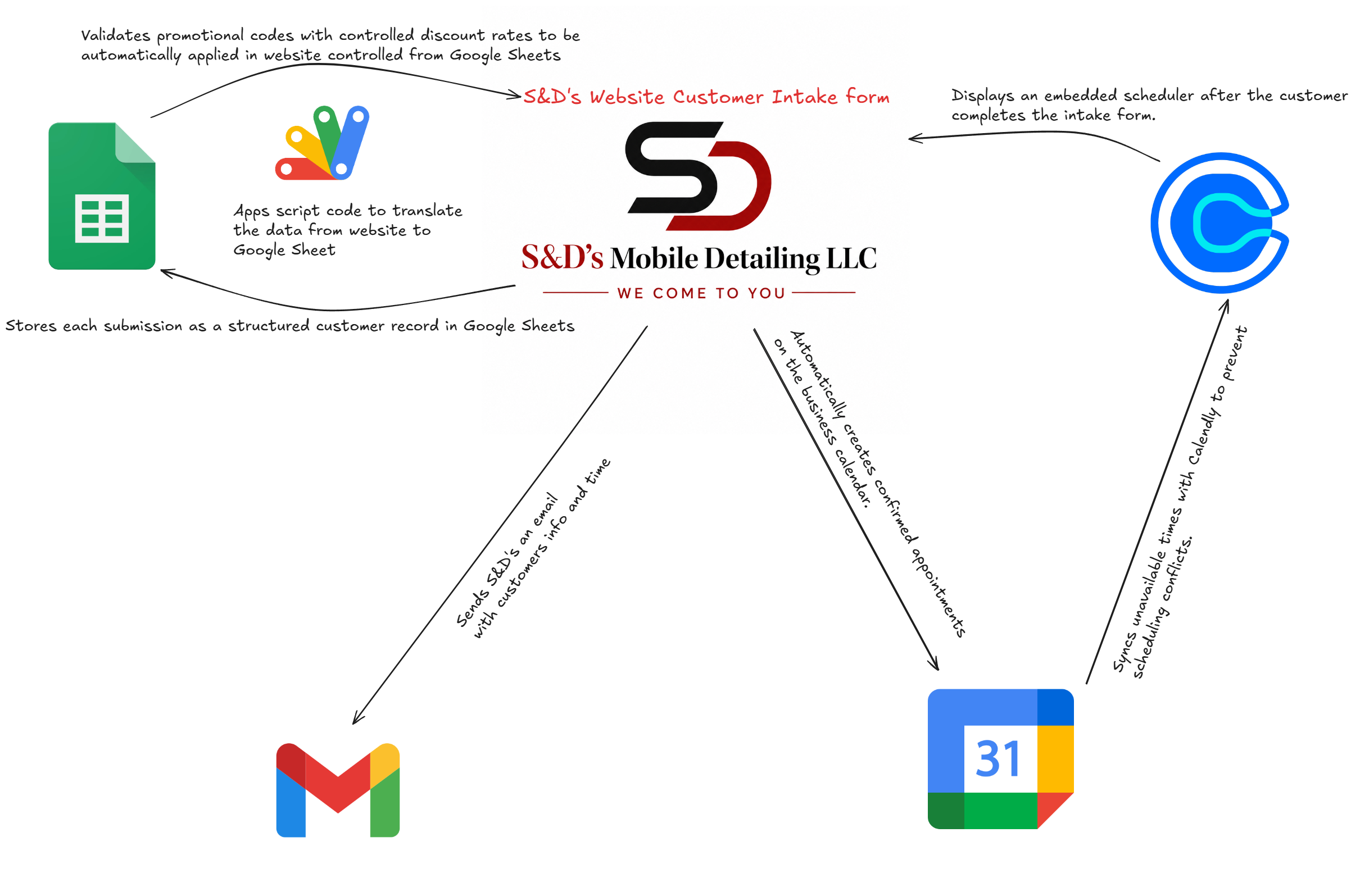
I designed the workflow so customer information enters once, passes through defined validation and routing steps, and becomes a traceable booking and operating record.
 Click to enlarge
The setup
A two-person LLC with defined operating roles
S&D's Detailing is a member-managed Illinois LLC I co-founded with a 50/50 partner. My partner leads field detailing and paint correction, while I lead the digital and business systems, including the website, customer communication, scheduling, pricing structure, and financial tracking. Because I also support service delivery, the tools were designed around the business's actual workflow and failure points—not an imagined process.
Intake & scheduling
- Built a three-page website with a required-field customer intake form.
- Validated submissions flow automatically into a structured Google Sheets record.
- Embedded scheduling uses current calendar availability and triggers immediate notifications.
Pricing & service
- Three standardized packages: Basic ($75), Exterior & Interior ($200), and Full ($275).
- Promotional codes are checked against a controlled discount table in Google Sheets.
- Standardized service checklists and final quality control make delivery repeatable.
Tracking & records
- Each request records the customer, vehicle, service, payment preference, notes, and job status.
- Payments and tips are recorded after each completed service.
- Expense and budget tracking records operating reserves, costs, and owner distributions.
A closer look
The customer intake pipeline
The system is built around a single-entry workflow. A customer completes one intake form; Google Apps Script validates the required fields and service-site acknowledgments, checks any promotional code against a controlled Google Sheets table, and creates a standardized operating record. The customer is then shown live scheduling availability, while the business receives an internal notification and the confirmed appointment synchronizes with Google Calendar.
01
Capture
Customer submits contact information, service address, vehicle details, selected package, payment preference, notes, and required service-site acknowledgments.
02
Validate
Google Apps Script verifies required fields, confirms acknowledgments, and checks any promotional code against the controlled discount table.
03
Record & notify
The validated submission is written to Google Sheets as a standardized record, and an internal email summary is sent to the business.
04
Schedule
The embedded Calendly scheduler appears after intake. Confirmed bookings synchronize with Google Calendar, while existing calendar events block unavailable times.
I built the backend as a Google Apps Script web application connected to Google Sheets. This kept the architecture lightweight—without requiring a separate paid server—while supporting input validation, promotional-code lookup, structured record creation, data routing, and email notifications. A script lock protects simultaneous writes so overlapping submissions cannot corrupt or overwrite the operating record.
Business impact
Reducing handoffs and preventable errors
One customer submission becomes one standardized record and one scheduling flow. Required-field validation reduces incomplete requests, the controlled discount table prevents inconsistent pricing, calendar synchronization reduces booking conflicts, and structured records make each job traceable. The result is less manual entry, fewer missed requests, and a process either owner can follow.
Why it's built this way
Designed to be repeatable
Every component has a defined input, validation step, output, and owner. Standardized service packages reduce pricing ambiguity; required fields prevent incomplete requests; Google Sheets provides a central operating record; scheduling checks real availability; and checklists standardize execution. The process can be audited, handed off, and expanded without relying on memory, scattered text messages, or undocumented knowledge.
Contact
Available for Summer 2027
engineering internships.
Open to design, MEP, process, manufacturing, and reliability roles — and to project work. The fastest way to reach me is email or LinkedIn.